

During the era of cold weapons such as Sabers, Swords, Spears, Pikes, Bows, Crossbows, etc. Kha's note: Cold weapons do not use gunpowder but rely on human strength or simple mechanisms (like bows, crossbows) to generate force., the role and rank of the saber (dao) were extremely important. Anyone who has read Louis Cha's (Jin Yong's) martial arts novels knows that many characters relied on legendary sabers and swords to roam the pugilistic world, avenge grievances, and gain widespread fame. Legendary sabers and swords like the Dragon-Slaying Saber and the Heavenly Sword were always the lifelong pursuit of martial arts heroes.
That is the pugilistic world in novels, but in real life today, there are still people as passionate about swords and sabers as martial arts heroes. Chen Rongliang, a Taiwanese man, is one of them. Carrying a dream of legendary sabers, he traveled from Taiwan to Yangjiang - the capital of cutlery in China. He persistently researched, overcame many difficulties, and successfully restored traditional Chinese sword-forging techniques, crafting sabers coveted by many fellow experts. Recently, the author interviewed him multiple times to uncover this untold story.

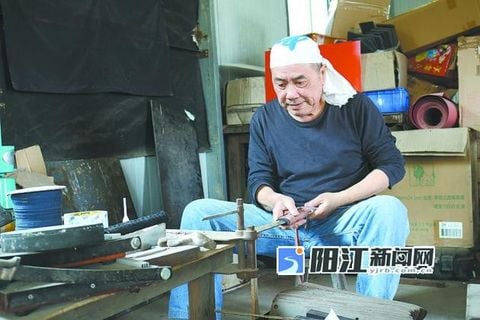
Chen Rongliang is making a knife handle.

Chen Rongliang instructs his apprentices in forging a freshly baked piece of precious steel.
1. Learning Kendo and worshiping legendary swords
Chen Rongliang, from Taichung, Taiwan, is 65 years old this year. He has loved martial arts since childhood, favored Kendo, and began practicing Kendo at the age of 13. At the age of 40, he achieved the rank of 6 Dan (六段, Rokudan) in Kendo. To achieve the rank of Rokudan (sixth degree), Kendo practitioners usually must have many years of experience and pass a rigorous evaluation exam.. 8 Dan (八段, Hachidan) is the highest rank. As a Kendo practitioner, owning a good sword to boost his skills was Chen Rongliang's dream. He first thought of buying a samurai sword from Japan, but upon hearing that even an entry-level samurai sword cost 70,000 yuan, he thought about forging one for himself.
The idea of forging a sword was like a seed, germinating in Chen Rongliang's heart. He searched for and studied many materials and research to restore traditional Chinese sword-forging techniques. He believed that Japanese sword-making techniques originated from ancient China, and that this traditional forging technique could be found if he returned to the mainland. A Kendo friend found him information about famous cutlery places like Longquan in Zhejiang and Yangjiang in Guangdong for him to choose from. After comparing, he chose Yangjiang because the climate here is pleasant, the scenery is beautiful, and he also understood a little Cantonese, which was convenient for communication.
In October 1999, at the age of 43, Chen Rongliang announced to his family and friends: "I want to go to Yangjiang to forge swords!" His family strongly opposed it, and friends advised against it, thinking he was gambling with his life as he entered middle age with heavy family responsibilities. Prior to that, he had been in the pharmaceutical business in Nanning, Guangxi. Although business did not go smoothly, he met many prominent figures in local culture, such as painter and calligrapher Du Guoquan, and became close friends. Once, while chatting with Mr. Du, Mr. Du said that "Chinese culture has bamboo as its root," which deeply moved him. He recalled that he had opened a company, worked as a chef, a painter, and an archery coach, but none of his ventures succeeded. He considered himself "foolish" (ngốc), and split the word "ngốc" into two parts: "trúc bản" (bamboo root) and used it as a symbol. Unexpectedly, "Zhuban" (Trúc Bản) became the brand for the swords he forged later.
2. Hard to find a master, opening a forge on his own
Flying from Taiwan to Hong Kong, transferring from Hong Kong to Guangzhou, and then taking a bus from Guangzhou, Chen Rongliang arrived in the unfamiliar city of Yangjiang to start a new life.
In October in Yangjiang, the weather was still hot. Chen Rongliang rented a house in the city and began searching for sword smiths. He walked through Yangjiang's industrial zones and discovered that businesses here mainly used modern equipment and techniques for mass-producing cutlery, unlike what he had originally envisioned.
While he was confused, a Taiwanese friend introduced him to a girl named Guan Xiaoyuan in Yangjiang. Guan Xiaoyuan ran an export cutlery business and was very enthusiastic in helping him. She drove him to look for blacksmiths in places like Chengxi and Tangping, but after more than a month, they found none. Reluctant to bother her further, Chen Rongliang bought a Jialing motorcycle to continue searching on his own. Hearing that the late master of small knife forging in Yangjiang, Liang Kefu, was from Pinggang, he went to Pinggang town to find a forge, talked to the blacksmiths, explained the type of sword he wanted to forge, and asked if they could make it and how much it would cost. The blacksmith replied that they could, and each sword would be 400 yuan. Chen Rongliang happily paid 500 yuan and agreed to order 20 swords per month, to take back to Taiwan after completion.
The sword Chen Rongliang ordered had to be forged from a block of iron, folded and hammered 13 times to ensure the hardness, flexibility, and sharpness of the blade. During that time, Chen Rongliang rode his motorcycle every day from the city to the forge in Pinggang to learn sword-forging techniques. He even hired a worker to sharpen the swords, but the swords made by the blacksmiths failed to achieve the desired quality no matter how they were sharpened. He also tried using steel instead of iron, but the results were still not ideal. After two years of experimentation, he had no success and discovered that the blacksmiths had faked the folding process and had not hammered it the required number of times. He stopped cooperating with that blacksmith.
Through failed attempts, Chen Rongliang lost quite a bit of money, but he understood that doing a job well cannot always be smooth sailing from the beginning. In over a year of interacting with blacksmiths, he had learned quite a few forging techniques. In the summer of 2001, Chen Rongliang decided to forge swords himself. He rented an abandoned old house of more than 80 square meters in the suburbs of Mayan, renovated it into a workshop, equipped it with a furnace, anvil, iron hammers, and a water tank, and bought coal and iron as raw materials, becoming a true blacksmith.
3. Continuous experimentation, exploring difficulties
In May 2001, as the weather gradually turned hot, the abandoned house in Mayan began to echo with the "clanging" sound of iron forging. The surrounding residents then discovered that an iron forge had appeared here. When they learned it was a Taiwanese man forging swords, everyone shook their heads: "What era is this to still be forging swords this way?"
Faced with skeptical gazes, Chen Rongliang felt very uncomfortable, but he was even more unwilling to accept failure. He hired a few workers, waking up at 5 a.m. every day to add coal to the furnace, burn iron, refine steel, hold heavy hammers to beat the glowing red iron blocks, and then plunge the iron into cold water to quench it. He repeated these steps over and over, and after many rounds of forging, he produced a sword blank. However, no matter how much sweat he poured, the results still did not meet requirements. When quenching the steel, the sword blank would often make a "ping" sound and crack, forcing it to be discarded. One night, when a quenched sword did not crack, he thought he had succeeded, but two or three hours later, he heard a "ping" sound again, and the sword blank left by the bed had cracked. During those days, the cracking sound of the sword blanks haunted him.
"Failure is the mother of success," Chen Rongliang comforted himself. He often went online to interact with peers, learn traditional sword-forging techniques, and meet sword-forging enthusiasts in Yangjiang to learn from them. He constantly experimented with new methods and adjusted his techniques. He even invited an 80-year-old mason to improve the clay furnace, using coarse sand, firebricks, and cement to reinforce the furnace. Afterward, he continued experimenting and finally found the technique to forge a sword that met requirements, with a sharp, sturdy, and durable blade.
4. Overcoming hardships, the legendary saber is born
As days passed, Chen Rongliang continued to experiment with different forging methods. News of his steel-refining and saber-forging spread across online fencing forums, causing sword-loving friends across the country to send him iron sand and iron ore from all over for his experiments. During that time, he refined steel and forged sabers day and night. Despite putting in so much effort, he still could not create a standard saber blank. After each failure, he would seriously summarize, inspect stages such as iron boiling, steel folding, hammering, and arrangement to adjust and improve in subsequent trials, finding ways to overcome technical barriers.
On a night in April 2006, after yet another failed experiment, Chen Rongliang stood before the forge pondering the cause. Suddenly, an idea flashed. He decided to burn coal in the clay furnace until 3 o'clock, when it reached optimal temperature, then mix iron sand from Baoding, Hebei with coal and pour it into the furnace in batches, continuing to bake and refine. He observed through the observation port of the clay furnace and saw that the sulfur in the iron sand had completely decomposed, then stopped adding coal. He took the refined steel out of the furnace, and after hammering and cooling, he realized it was a block of jade steel weighing about 5-6 kg - a Chinese version of jade steel! This discovery filled him with immense joy, nearly making him jump in the room. He knew that by refining jade steel, he had come very close to success.
After numerous experiments and adjustments, in July 2006, Chen Rongliang successfully forged a high-grade folded steel saber, achieving ideal hardness and toughness, and creating the temper line on the blade that he had long desired, comparable to swords crafted by Japanese masters. He also found that his burning and sharpening techniques had improved, making the gas lines and boiling lines on the blade clearer. He summarized the entire manufacturing process of this saber.
Holding this nearly perfect and precious legendary saber in his hands, Chen Rongliang was deeply moved. He felt that Yangjiang was a precious land and he had chosen the right place to come. To reach this moment, he had spent 6 years, discarded over 500 ruined saber blanks, and fallen heavily into debt. He persistently overcame consecutive failures and finally discovered the secrets of traditional saber forging.
Later, for various reasons, Chen Rongliang moved his workshop multiple times. In 2013, he rented a plot of land of about 2,000 square meters in the Longtoushan Industrial Zone, Beiguan Town, Yangjiang and built a simple workshop. Since then, he has settled here.
5. Quality is the core, the core makes a strong saber
Chen Rongliang carves the "Zhuban" seal onto the swords and sabers he crafts. Over the past 10 years, "Zhuban Swords and Sabers" have become famous for their outstanding quality. However, he still quietly focuses on researching traditional saber-forging techniques, constantly seeking new breakthroughs. At the same time, he brings Zhuban swords and sabers to international exchange activities, letting the world know the beauty of traditional Chinese swords and sabers.
In 2008, Chen Rongliang pitted his sabers against Japanese swords for the first time. At that time, a Kendo competition was held in Taiwan, and he brought his saber to participate, facing Sugano Shigeru, the vice president of a Japanese Kendo association. During the "test-cutting" session, Sugano Shigeru used his Japanese sword to cut gently through a tatami mat. Chen Rongliang handed his saber for him to try cutting, and a look of contempt was evident on Sugano Shigeru's face when he learned this saber was made by a Chinese person. However, when he held the saber and slashed hard, the blade sliced through the air as if nothing, and the tatami mat was cut cleanly in half. Because he swung too hard, Sugano Shigeru lost his balance and almost fell. When he recovered, he stood straight and respectfully said to Chen Rongliang: "Your saber is truly wonderful."
In February 2020, Chen Rongliang participated in a knife exhibition in Las Vegas, USA. During the demonstration, he held the saber in his left hand, blade facing up, and ran his right thumb along the edge without cutting his hand, stunning the audience. Afterward, he held a sheet of paper in his left hand and gently dragged the blade across the edge of the paper, creating a perfect cut. He explained to the audience that this saber was crafted according to traditional Chinese methods, using iron sand as raw material, going through 64 stages of steel refining, heating, forging, and sharpening to completion. Since 2007, he has participated in international knife exhibitions consecutively for over 10 years and sold out all his sabers within two to three days each time.
In 2012, Chen Rongliang was awarded the certificate of "Senior Traditional Sword and Saber Craft Master" by the Department of Human Resources and Social Security of Guangdong Province. In May 2017, the traditional sword and saber manufacturing technique project was included in the municipal intangible cultural heritage list, and in July of the same year, Chen Rongliang became the representative inheritor of the municipal intangible cultural heritage. Currently, this project is being prepared for nomination to the provincial intangible cultural heritage list. In 2019, at the national sword and saber craftsmanship competition, his work "Chinese Sword (Small)" won first place.
Chen Rongliang shared that he has resolved the core heat treatment technology of traditional saber-forging methods, creating swords and sabers with the best hardness and toughness, extremely high wear resistance, and good shock absorption. However, this traditional technique is profound and requires further research to forge flawless traditional swords and sabers.
After the story of Chen Rongliang's saber forging spread, instrument manufacturing businesses from elsewhere wanted to invite him with high salaries, but he remained unfazed. He has considered himself a Yangjiang local and wants to continue his research here. "As a Chinese person, I have the responsibility to promote traditional saber-forging techniques," Chen Rongliang said.
6. A lifetime of skill, looking forward to an inheritor
Shortly after the Lunar New Year in 2021, in front of Chen Rongliang's small workshop in the Longtoushan Industrial Zone, Beiguan Town, two large, healthy Taiwan green apple trees were laden with lush green fruit.
Everything in the workshop remains just as it was 7 years ago: the clay furnace used for over a decade, the red brick furnace still standing firm, and the pneumatic hammer manufactured in 1965 by the Anyang Forging Equipment Factory in Henan. These old, heavy, and unmodern tools are, in Chen Rongliang's eyes, spiritual treasures full of vitality.
Normally, Tran Vinh Luong lives a reclusive life in his workshop, eats simply, but feels fulfilled because he has devoted all his enthusiasm to researching traditional sword forging techniques, becoming a true modern "artisan". He said that he only forges about 20 swords a year, and in 2020 he only forged 7. He does not focus on the quantity of swords, only caring about the quality.
Currently, Tran Vinh Luong is teaching two apprentices who have been with him for about 16-17 years. Normally, he is responsible for quenching the blades, one apprentice is responsible for tempering the steel and forging the blades, and the other apprentice is responsible for grinding the blades. He believes that the blade-quenching process is the most important and difficult technique to grasp, as well as the hardest "key" step to learn. He hopes that the two apprentices will master all the techniques.
As he grows older, Tran Vinh Luong worries that the traditional techniques he has researched might be lost, so he is looking for a successor. He said his son used to follow him in forging swords for a few years, but lost interest and returned to Taiwan. He hopes to find a young person with intuition and a strong work ethic in Yangjiang to pass on his craft, so that traditional Chinese sword-making techniques can be passed down from generation to generation.
In Tran Vinh Luong's eyes, traditional sword forging is not just a profession or a technique, but also a culture and an artisan's spirit. The descendants of the Yan and Huang emperors on both sides of the strait need to jointly pass on this culture and spirit, so that our country and nation have hope.
(Original work by Yangjiang Daily, translated with permission by Le Trong Kha (with annotations to help readers understand better) from https://news.yjrb.com.cn/articles/yaowen/20210201/221125.html)