

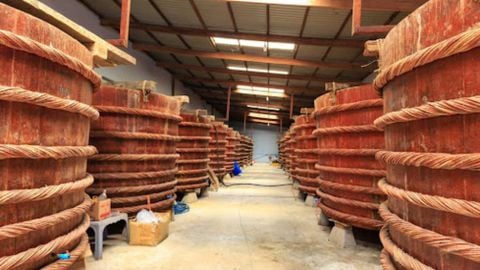
- Raw materials for fish sauce processing: sea fish (anchovies) and NaCl salt.
- Tools for fish sauce processing: wooden vats (crape myrtle, etc.) and ceramic funnels, the fish is continuously stirred until the mash (i.e., salted fish) is ripe, then consecutive extraction is carried out.
- Ripening time: from 8 months or more.
- The steps are summarized according to the above process.
PROCESS
Receiving Raw Materials —> Salting Fish (2 times) —> Tending the Mash —> Extracting Fish Sauce —> Settling and Filtering —> Bottling, Labeling —> Boxing.

PROCESS DESCRIPTION
1. Processing raw materials fish sauce: sea fish and NaCl salt.
2. Fish sauce processing tools: wooden vats (crape myrtle, etc.) and ceramic funnels, the fish is stirred continuously until the mash (i.e., salted fish) is ripe, then consecutive extraction is carried out.
3. Ripening time: from 8 months or more.
4. The steps are summarized according to the above process.
FISH SAUCE PROCESSING TECHNOLOGY
Fish sauce is a protein solution consisting mainly of amino acids, formed by the process of fish protein hydrolysis thanks to the protease enzyme system present in the fish. In addition, fish sauce is also used to treat a number of ailments such as stomachache, burns, physical exhaustion, and provides energy.
Fish sauce is produced in almost all Asian countries. Each country has a different production method creating products with different nutritional and sensory values.
Nutritional value of Fish sauce
Protein substances
Account for the majority and determine the nutritional value of fish sauce. Consists of 3 types of protein
– Total nitrogen: is the total amount of nitrogen present in fish sauce (g/l), determining the grade of the fish sauce.
– Amino nitrogen: is the total amount of protein in the form of amino acids (g/l), determining the nutritional value of fish sauce
– Ammoniacal nitrogen: the higher the content, the lower the quality of the fish sauce.
In addition, fish sauce also contains a full range of amino acids, especially essential amino acids: valine, leucine, methionine, isoleucine, phenylalanine, alanine, etc. Other components with larger sizes such as tripeptides, peptones, dipeptides. It is these intermediate components that make fish sauce easily spoiled due to the activity of microorganisms.
The nutritional composition of fish sauce depends on the raw materials used for processing.
Volatile substances
Very complex and determine the flavor of fish sauce.
Content of volatile substances in Fish sauce mg/100g of fish sauce
– Volatile carbonyl substances: 407-512 (formaldehyde)
– Volatile acids: 404-533 (propionic)
– Volatile amines: 9.5-11.3 (isopropylamine)
– Volatile neutral substances: 5.1-13.2 (acetaldehyde)
The odor in fish sauce is formed mainly by the activity of anaerobic microorganisms during the fish sauce production process.
Other substances
– Inorganic substances: NaCl accounts for 250-280g/l and some minerals such as: S, Ca, Mg, P, I, Br.
– Vitamins: B1, B12, B2, PP.
Fish hydrolysis process
The nature of the fish sauce production process
The nature of this process is the hydrolysis of protein into amino acids.
The main products of protein decomposition are amino acids and low-level peptides.
According to Beddow's research, the three steps of formation and conversion of ES compounds correspond to 3 stages of nitrogen compound transformation during fish hydrolysis.
– Phase 1 (0 – 25 days): There is an increase in the volume of the liquid portion floating on the surface of the product and soluble protein.
– Phase 2 (80 – 120 days): Cell walls are broken down, cellular proteins are brought into contact with enzymes, products of protein autolysis are released. Almost all cell tissues are decomposed and disappear after 120 – 140 days. – Phase 3 (140 – 200 days): Enzymes are released and attack soluble protein parts. This is the cause of changes in nitrogen compounds.
In addition, sugars and fats are also decomposed into alcohol and organic acids.
Enzyme systems in fish sauce production
Consists of 3 major enzyme systems
a. Metallo-protease enzyme system (Aminodipeptidase)
This enzyme system exists in the internal organs of fish and can withstand high salt concentrations, so from the very beginning it operates strongly, gradually decreasing from the 3rd month onwards. This type of enzyme has fairly strong activity, capable of wide hydrolysis of peptides. This is a neutral enzyme hydrolysis group, optimum pH from 5-7, pI = 4-5, it is stable with Mg2+, Ca2+ ions and loses activity with Zn2+, Ni2+, Pb2+, Hg2+, etc.
b. Serine-protease enzyme system
Typically the trypsin enzyme, which exists abundantly in the internal organs of fish. At the early stage of production Fish sauce its activity is weak until the 2nd month and gradually develops to reach a maximum value in the 4th month, then gradually decreases until the mash ripens (protein is almost completely decomposed and no longer in the form of peptone). This enzyme system is always inhibited by the amino acid chain in the enzyme structure. To remove this chain, the activity of cathepsin B enzyme is needed, but cathepsin B enzyme is easily inhibited by high salt concentrations. Therefore, for cathepsin B enzyme to operate, the multi-salting method is applied. The serine-protease enzyme operates strongly at pH from 5-10, most strongly at pH=9.
c. Acid-protease enzyme system
Found in fish meat and internal organs, typically cathepsin D enzyme. This enzyme system is easily inhibited by a salt concentration of about 15%, so it usually only exists for a short time at the beginning of the hydrolysis period. This type of enzyme plays a secondary role in the fish sauce production process.
Microorganisms in fish sauce production
– Origin: from raw materials, tools, equipment, environment (air, water). When microorganisms invade the mash, they have the following effects:
– Participate in the protein hydrolysis process but very weakly because they are inhibited by high salt concentrations.
– Actively participate in shaping the flavor of fish sauce, mainly flavor-producing anaerobic microorganisms.
Factors affecting the fish sauce processing process
Temperature
As temperature increases, the reaction rate increases, up to a certain temperature it will no longer increase and may decrease because high temperatures cause the serine-protease enzyme system to lose activity. The hydrolysis process is poor.
– Temperature of 30 – 47oC is suitable for the mash processing process.
– At temperatures of 70oC and above, most enzyme systems in fish lose activity.
Raise the temperature of the mash by sun-drying, cooking, or using hot corrugated iron to cover the workshop.
PH
Each enzyme system has a different optimum pH, so it is necessary to see which type of enzyme is most abundant and plays the most primary role in the fish sauce production process to create a suitable pH for that enzyme to operate. Experiments show that:
Natural environmental pH from 5.5-6.5 allows trypsin and pepsin enzymes to operate, and at the same time, this pH partly inhibits putrefactive bacteria. Therefore, the natural environment has a pH more suitable for the fish sauce production process.
Amount of salt
Salt is an important raw material for the fish sauce production process; without salt, fish sauce cannot be formed. The requirement for salt in fish sauce production must be food-grade salt, the purer the better, small crystalline grains with high hardness, pearly white color (no lumps, moisture, bitter-astringent taste).
– Low salt concentration has the effect of promoting faster protein hydrolysis and quicker mash ripening.
– Excessively high salt concentration inhibits and deactivates enzymes, slowing down the hydrolysis process, prolonging the hydrolysis time (protein is precipitated by saturated neutral salt).
To process mash quickly, it is necessary to determine the amount of salt added to the mash, and this amount of salt must satisfy 2 conditions:
– Not too salty to avoid inhibiting enzyme activity.
– Not too bland to have sufficient capacity to inhibit the growth of putrefactive bacteria.
Usually, the amount of salt added is about 20-25% compared to the weight of the fish. The method of adding salt in multiple times should be implemented, and it is necessary to determine the number of salt additions, the salt ratio for each time, and the interval between salt additions so as not to affect the fish sauce production process.
Contact surface area
For the reaction to happen quickly, there must be good contact between the enzyme and the substrate. Enzymes in fish are concentrated heavily in internal organs, so to increase the hydrolysis rate, ways are found to increase the contact area between the enzyme and fish meat. Measures can be used:
– Method of mincing fish:
+ Fine grinding of fish will increase the contact surface area, but proteins are easily denatured due to mechanical action.
+ Enzymes are dispersed, but very widely into the aqueous environment, diluting the enzyme concentration. When the fish sauce mash (chuop) is mature and drained, clogging may occur.
– Crushing method: Crushed fish retains its original shape, the inner muscle tissue softens, and the loose muscle structure allows enzymes to easily penetrate into the meat. The fish bones are not broken into pieces, making it easy to drain when the fish sauce mash is mature.
– Cutting into chunks method: The fish meat remains firm, so enzymes are less penetrating than in the crushing method, and proteins on the outer surface are easily denatured due to contact with high-salt-concentration solutions.
Thus, to increase the contact surface area, using the crushing method combined with stirring the fish sauce mash is best.
The raw materials themselves
Different fish species have different chemical compositions and structures, especially the enzyme system in fish, thus creatingFish sauce of varying qualities.
– Fresh fish processes into better quality than spoiled fish.
– Fish with a loose, soft muscle structure and few scales are easier to process than hard, firm fish with many scales.
– If the fish is fatty, fish sauce will have an unpleasant rancid odor, sour odor (due to the hydrolysis of fats into fatty acids and glycerides), or a burnt odor due to fat oxidation.
– Fish living in the surface and middle water layers such as mackerel, anchovies, scad, sardines, etc., yield the best quality fish sauce because they feed on good food, resulting in high nutrition and protein content.
– Fish living in the lower and bottom water layers such as goatfish and lizardfish yield fish sauce of poor quality due to a lack of food (eating algae, moss, mud, or bottom plants), making the fish meat lack nutrition and the fish belly contain mud and dirt, which affects the color of the fish sauce liquid.
Criteria for evaluating mature fish sauce mash
* Sensory
– Color: fresh brown, brownish-gray, or gray. Specifically, the first-press extract ranges from straw-yellow to cockroach-wing color.
– Characteristic aroma, free from sour or strange odors.
– State
+ For pressed fish sauce mash: fish remains whole, if torn the meat separates from the bone, if stirred the meat crumbles.
+ For stirred fish sauce mash: fish is mashed, the mash is bright, and no foaming occurs when stirred.
* Chemical: 2 factors
The ratio of amino nitrogen to total nitrogen in the first-press extract.
+ For pelagic fish mash, this ratio is > 45%.
+ For demersal fish mash, this ratio is > 40%.
Preservation of fish sauce
Thanks to salt and high protein content, a large osmotic pressure is created to inhibit the activity of microorganisms. High protein content allows for a very long storage time ranging from one year to decades, though the flavor diminishes.
Containers must be cleaned thoroughly.
Above is the general fish sauce production process for everyone's reference. As for the secret to creating delicious fish sauce, many other factors determine it, related to the quality of fish, salt, the method of salting and fermenting the mash, and the fermentation environment to create different flavors and classes of fish sauce.