

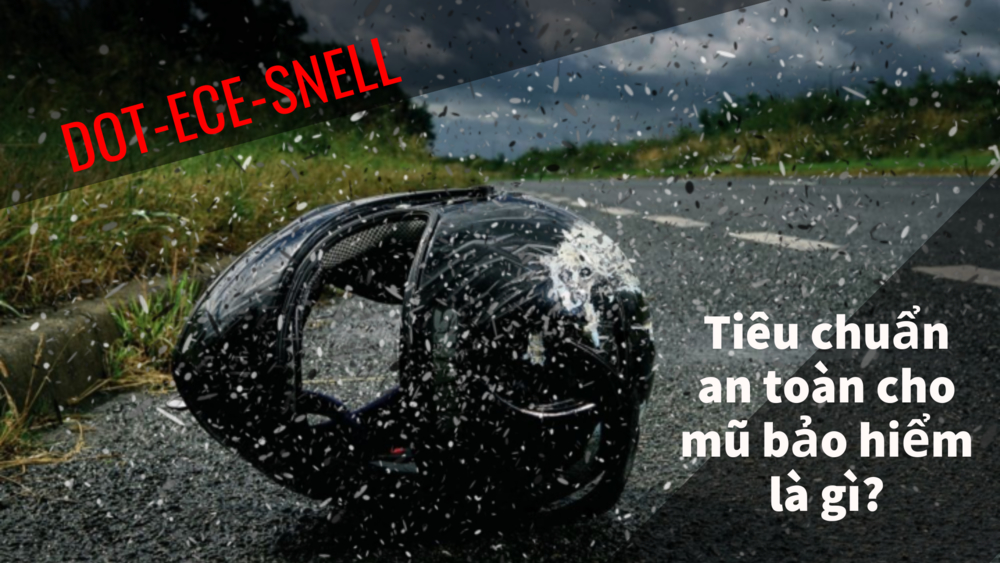
 When driving on the road, there will be times when unexpected accidents happen that you cannot foresee. For cars, seat belts combined with airbags significantly reduce the impact force causing injury to the body. As for motorbikes, the risk of head injury increases many times over, with your head likely to collide with the road surface, handlebars, or even oncoming vehicles. Therefore, a helmet with quality and design meeting safety standards is your savior, protecting you from serious head injuries. So what are the safety standards for helmets?

European, American, and developed countries in general are already too familiar with the helmet safety assessment standard sets on the market: DOT, ECE, SNELL, or MIPS. Based on these safety regulations, consumers can know the quality testing methods that have been conducted on that helmet, thereby knowing its protection capability and level.
DOT Safety Standard

The United States Department of Transportation (abbreviated as "DOT") is the unit that issues the DOT safety standard set for helmets. This standard set specifies the tests that a helmet must pass before being released to the market in the US. Consumers can easily recognize helmets meeting this standard by the DOT symbol located at the back of the helmet's neck.

Most helmets in the US have a DOT certification stamp, and this standard has gone beyond US borders to be widely used in many other countries. The DOT safety standard includes tests for impact absorption, penetration resistance, and the sturdiness of the helmet strap. The magnitude of the impact force at each level is specified and issued by DOT.

However, the DOT regulatory set still has some unreasonable points. First, the DOT standard set still has not had any revision since 1972, meaning that the DOT safety standard has not changed for nearly 50 years. Second, the DOT standard is a self-binding and self-assessing standard set, meaning that helmet manufacturing and design companies conduct their own tests (according to DOT standards) so the evaluation will be subjective, and they can label it with DOT whenever they feel the product has met the standard. Therefore, all helmets bearing the DOT label are standard in theory until the US Department of Transportation conducts random testing of helmet models on the market.
The DOT safety rating system has been criticized by many people, for example, Fortnine.ca in this video, for relying entirely and too much on helmet manufacturing companies. However, DOT-certified helmets are still better than 90% of non-standard helmets in Vietnam.
ECE 22.05 Safety Standard

The Economic Commission for Europe - Economic Commission for Europe (ECE) - has also issued its own set of test regulations for helmets used in road traffic. This standard set has been updated many times by the Economic Commission for Europe since its issuance, with the first version named ECE 22, and the current standard set being in its fifth update version (ECE 22.05).

The ECE safety standard set is said to be stricter than DOT, with tests for impact absorption, penetration resistance, and strap sturdiness. ECE is currently the most popular safety standard set in the world with over 50 countries recognizing it as their official safety standard set.
With standard-compliant helmets, you will see the ECE symbol at the back of the helmet's neck (similar to DOT) along with the code of the country that performed the test on the helmet strap. For example, if you see the symbol E6 on a helmet's strap, it means this helmet was ECE-tested in Belgium.
The only drawback of the ECE standard set is that: tests are only performed at a fixed position on the helmet body, and that test position has never changed. If a manufacturer wants a helmet model to meet the ECE standard, they simply need to reinforce the tested position, and pass easily.
Country codes on the straps of the ECE standard:
- E1: Germany
- E2: France
- E3: Italy
- E4: Netherlands
- E6: Belgium
- E11: UK
ECE is not a perfect standard set, however, it can be said that all ECE-certified helmets have undergone safety inspection tests.
SNELL Safety Standard

It is very difficult for an average consumer to distinguish which safety standard set is "best" or "safest". However, SNELL claims itself to be "the highest safety standard set for helmets"the highest safety standard set for helmets"
Unlike DOT's inspection process and safety standard levels, for SNELL, the manufacturer must register for testing for their helmet model, and after submitting test samples and being granted a safety standard certificate from SNELL, the helmet model is officially allowed to bear the SNELL symbol.

Compared to DOT, both SNELL and DOT test the impact force of the helmet body during flat surface collisions, then measure the G-force transmitted through the inner helmet liner (the lower, the better). DOT specifies that the maximum G-force transmitted through the helmet liner is 400G, and Snell specifies 300G. SNELL claims that all of its tests are equal to or more difficult than DOT's equivalent tests. Therefore, a SNELL-certified helmet will definitely meet DOT standards, but a DOT-certified helmet does not necessarily meet SNELL standards.
The following table compares the test results between SNELL and DOT

SHARP Safety Standard

SHARP is a safety standard set developed by the UK Department for Transport, with the aim of making it easier for consumers to evaluate the quality and safety of helmet models on the market, while providing information on sizing standards and other helmet features if any.
SHARP also sets standards for safety tests much higher than all the above standard sets.Specifically, for tests on flat surface impact absorption capacity, SHARP raises the impact force 30% higher than ECE's test in the same category.

SHARP claims that "every helmet model must pass 30 tests on vertical direct impact absorption capacity, and 2 tests on 45-degree oblique impact absorption capacity to achieve the SHARP safety standard. These 32 tests must be performed on 7 helmets of that model, at 3 different impact speeds (6, 7.5, and 8 m/s) according to the table below:

SHARP also performs tests on the chin bar area of the helmet. Modular helmet models also have separate tests to evaluate safety based on the number of times the jaw opens or flies off during a collision. A helmet's impact absorption capacity is represented by SHARP using color codes on the helmet body, and then scored on a scale of 1 to 5 stars.
MIPS Technology for Helmets

MIPS stands for Multi-directional Impact Protection System - temporarily translated as Multi-directional Impact Protection System, which is actually a special helmet liner capable of sliding independently by a distance of 10-15mm in all directions compared to the helmet shell.
When an impact occurs, the helmet wearer's head is likely to be endangered by two types of forces: direct impact force and rotational force.

Almost everyone can understand and visualize how impact force is generated in a collision. But where and how is rotational force generated? When a high-speed collision occurs, due to friction between the human body and the impact surface, the rider's body parts always tend to rotate and tumble multiple times. Typically, in Moto GP accidents, most of the riders' bodies are thrown and tumble multiple times before stopping. A similar rotational force is generated between the head and the helmet, and is the main cause of most head and brain injuries, since not all helmets are equipped with MIPS technology. By allowing the brain and head to rotate independently of the helmet shell, MIPS can significantly minimize the impact of rotational force on the user's brain.

Helmets with MIPS technology are now widely applied in high-risk sports such as mountain biking, enduro racing, motocross, and snow sports. However, MIPS also increases the price of the helmet by $20 - $50, and also accounts for a portion of the helmet's weight.
So which safety standard helmet should you choose?

The safest is probably a helmet that fully meets all DOT, ECE, and SNELL standards and is additionally equipped with MIPS technology, but that also means its price will not be cheap at all, sometimes equal to the value of the bike you are riding. And you also need to consider the intended use of the helmet you are about to buy.
In reality, you only need a helmet that meets one of the aforementioned standards for your daily usage needs. If you own a large displacement motorcycle, frequently go on multi-day tours, or participate in adventurous activities that require riding at high speeds, you need to consider a helmet that meets higher safety standards and integrates more technologies.
Most people still underestimate the safety and importance of a helmet, as the most popular type of helmet on the market today is still probably the half-shell helmet, which is only slightly thicker than a baseball cap.